
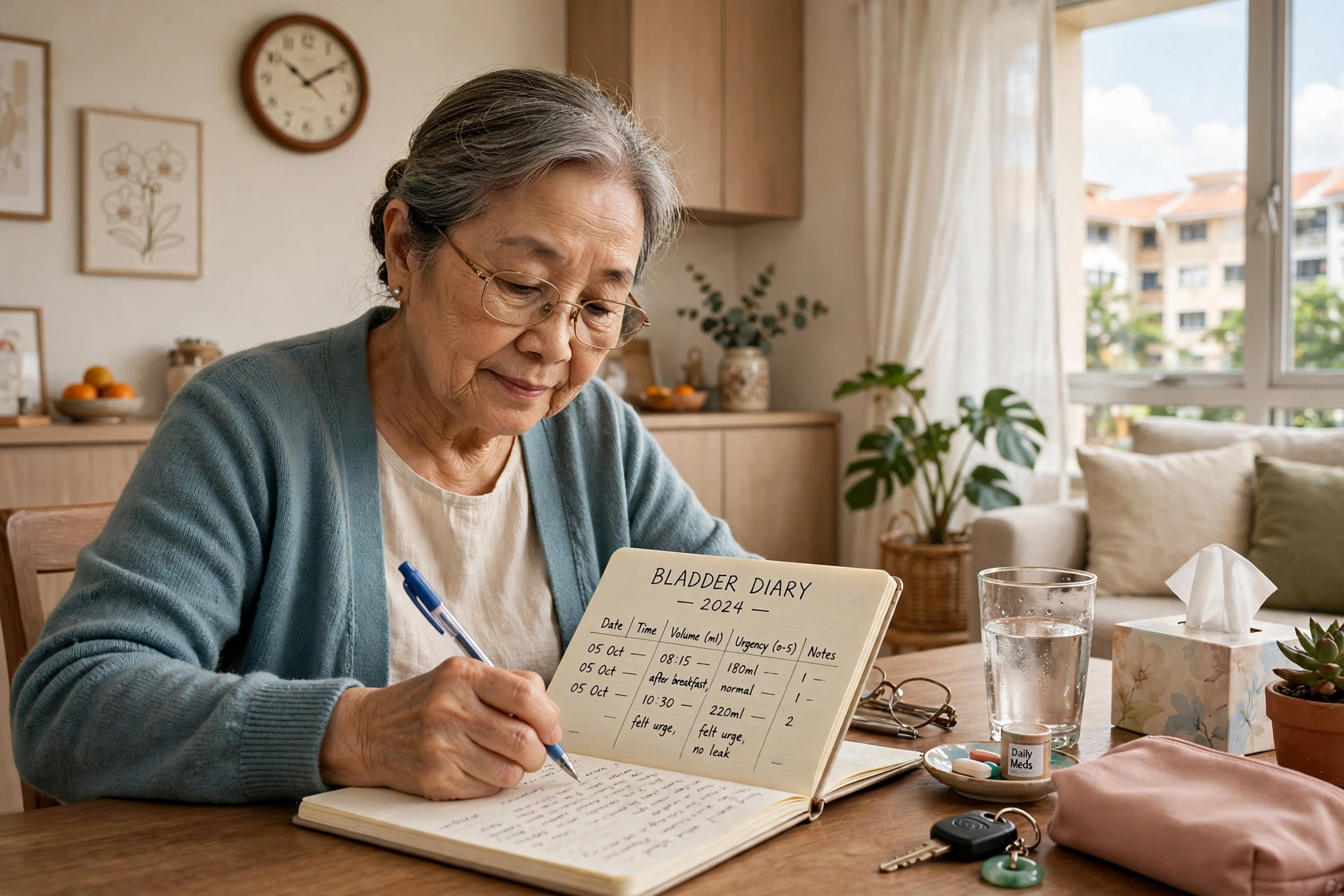
Do you plan your day around the nearest toilet, rush the moment an urge strikes, or go “just in case” before leaving home — yet the urges keep coming more often? Bladder training for incontinence is a simple, free method that retrains your bladder to hold more urine, for longer, so sudden urges become less frequent and easier to control.
This guide explains it step by step: who it helps, how to keep a bladder diary, how to stretch the time between visits safely, and what to do when an urge hits.
What is bladder training, and who does it help most?
Bladder training means going to the toilet by the clock instead of by the urge. You follow a set schedule and very gradually make the gaps longer. Over weeks, the bladder holds a little more, and the brain stops treating every small signal as an emergency.
It helps most with urge incontinence and overactive bladder — a sudden, strong urge with little warning, sometimes with a leak on the way to the toilet. It also helps mixed incontinence, where urge leaks happen alongside stress leaks when you cough or laugh. Not sure which type you have? Our guide to the types of urinary incontinence explains how to tell them apart.
It pairs well with pelvic floor exercises for urinary incontinence — exercises strengthen the muscles; training retrains the habit and the urge.
Who should check with a doctor first?
Bladder training is gentle, but not for everyone straight away. Check with your doctor first if you:
- often cannot empty fully, or your flow is weak or stops and starts,
- have diabetes, a nerve condition, or have had a stroke,
- have had recent bladder, prostate or pelvic surgery,
- keep getting urine infections,
- are a man with prostate symptoms, or are pregnant.
Delaying visits when the bladder cannot empty properly can make things worse, so check first. Your GP or polyclinic doctor can also rule out treatable causes of urgency, such as an infection.
Step 1: Keep a bladder diary for 3 days
You cannot improve a pattern you cannot see. For 3 ordinary days, note down:
- the time, amount and type of everything you drink,
- the time of each toilet visit, and roughly how much urine you passed, if you can measure it,
- every strong urge — what you were doing, and whether you leaked,
- possible triggers, such as coffee, running water, or arriving home.
This reveals your usual interval — for example, every hour, or every 45 minutes after coffee. That interval is your starting point.
Step 2: Bladder training for incontinence, step by step
- Empty your bladder first thing in the morning. That starts your schedule.
- Set your first interval: your usual gap from the diary, plus 15 minutes. If you normally go every hour, aim for every 1 hour 15 minutes.
- Go by the clock, not the urge. Go at each scheduled time, even if the urge is mild, and try not to go in between — use the urge techniques below to help you wait.
- Hold the new interval until it feels comfortable — usually several days to a week, with no leaks in between.
- Add another 15 minutes and repeat, building slowly towards 2.5 to 3 hours between daytime visits.
- Keep recording in your diary, so you can see the gaps getting longer.
Do not hold on for as long as you possibly can — stretching too fast makes urgency worse. Small, steady steps retrain the bladder.

Step 3: When the urge strikes — urge suppression techniques
Urges come in waves — they rise, peak, and usually pass within a minute or two if you do not rush. When one hits before your scheduled time:
- Stop and stay still. Sit down if you can. Rushing makes a leak more likely.
- Breathe slowly and relax your shoulders and tummy. Tell yourself: “I can wait. The urge will pass.”
- Do 5 to 10 quick pelvic floor squeezes — squeeze and lift for one second, let go completely, repeat. These quick flicks help calm the bladder muscle. A longer, steady squeeze can help too.
- Distract yourself. Count backwards from 100, or focus closely on a task. A busy brain turns the volume of the urge down.
- Wait for the wave to fade, then carry on until your scheduled time — or walk calmly, never run, to the toilet if it is time.
Habits that support your training
- Do not cut fluids drastically. Concentrated urine irritates the bladder and worsens urgency. Most adults do well with about 1.5 to 2 litres a day, unless a doctor has advised otherwise.
- Time your drinks. Drink steadily rather than in large gulps, and ease off in the last two hours before bed if night-time trips trouble you.
- Watch the irritants. Caffeine, alcohol, fizzy drinks and very spicy food worsen urgency for many people. Cut back for a week or two and check your diary.
- Avoid “just in case” visits. Going before you need to teaches the bladder to signal earlier.
How long does it take, and what about setbacks?
Give bladder training 6 to 12 weeks. Most people notice the intervals stretching within a few weeks, but lasting change is gradual.
Setbacks are normal — an infection, poor sleep, stress, constipation, or an extra coffee can bring urges back for a few days. Do not give up or start over: drop back to the last comfortable interval, hold it until things settle, then build up again.
When to see a doctor soon
Book a check-up promptly if you have blood in your urine, pain or burning when passing urine, repeated infections, a sudden change in bladder habits, a fever, or you cannot pass urine at all. If leaks affect your sleep, confidence or daily life — or training has not helped after about 3 months — that alone is reason enough to ask for help.

While you train, stay comfortable and confident
Retraining takes weeks, and life does not pause in the meantime. The right absorbent product lets you go about your day without worrying about leaks while the training does its work. Unsure which size or style suits you? A trial pack is an easy way to find out at home.
A retrained bladder, stronger muscles, and the right protection — together, they make incontinence far more manageable.
This article is general information only and is not medical advice. Incontinence has many causes, some of which need medical treatment — please see a doctor for a proper diagnosis, and check with your doctor before starting bladder training if any of the conditions in this article apply to you.