

Leaking a little urine when you cough, laugh, sneeze or rush to the toilet is very common — especially after childbirth, after prostate surgery, and as we get older. It is common, but it is not something you simply have to live with. For many people, the first and most effective step is also the simplest: strengthening the pelvic floor muscles with regular exercises, often called Kegel exercises.
This guide explains what the pelvic floor does, how to find the right muscles, and how to do the exercises correctly, step by step.
What is the pelvic floor, and why does it matter?
The pelvic floor is a hammock of muscles that stretches across the bottom of your pelvis. It supports your bladder, bowel and (for women) the uterus, and it wraps around the openings you use to pass urine and stools.
When these muscles are strong, they squeeze shut at the right moments — for example when pressure builds up in your abdomen as you cough or lift something heavy. When they are weak or damaged, that squeeze is too slow or too weak, and urine leaks out. This is the most common type of leakage, called stress incontinence.
The good news: like other muscles in the body, the pelvic floor responds to training. Done correctly and consistently, pelvic floor exercises may reduce leaks — or stop them altogether — for many people.
Step 1: Find the right muscles
Before you can train the muscles, you need to know what they feel like. Two ways to find them:
- The stopping test. Next time you pass urine, try to stop the flow midstream. The muscles you squeeze to do that are your pelvic floor muscles. Use this only as a test to locate the muscles — do not do it regularly as an exercise, as stopping your urine flow often can irritate the bladder.
- The lifting feeling. Imagine you are trying to stop yourself from passing wind, and at the same time trying to stop urine from flowing. You should feel a squeeze and a slight lift inside, not a big movement on the outside.
If you are doing it right, your stomach, thighs and buttocks stay relaxed, and nobody watching would know you are exercising. That is the beauty of these exercises — you can do them sitting, standing or lying down, at home, at work, or on the bus.
Step 2: The basic exercise
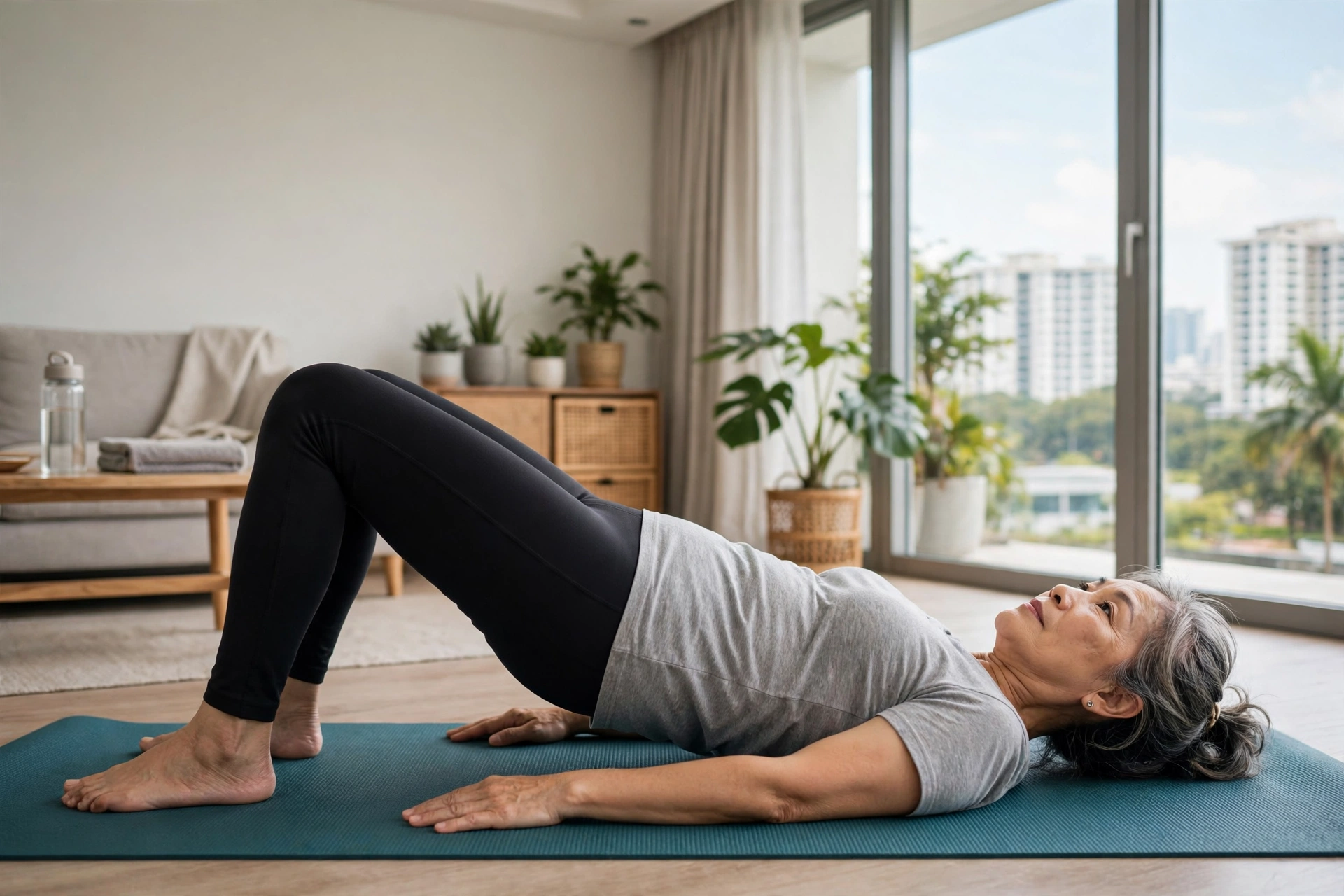
- Sit comfortably or lie down with your knees slightly apart. Breathe normally.
- Squeeze and lift your pelvic floor muscles, as if stopping urine and wind at the same time.
- Hold the squeeze for 3 to 5 seconds while you keep breathing. (As the weeks pass, build up to holding for up to 10 seconds.)
- Relax completely for the same number of seconds. The relaxing is just as important as the squeezing — the muscles need to fully let go before the next repetition.
- Repeat 8 to 10 times. That is one set.
- Aim for 3 sets a day, spread through the day.
Once the slow holds feel manageable, add quick squeezes: squeeze and lift for just 1 second, then let go completely. Repeat 8 to 10 times. These train the muscles to react fast — exactly what you need when a cough or sneeze catches you by surprise.
Common mistakes to avoid
- Holding your breath. Keep breathing steadily throughout. If you find yourself holding your breath, count out loud while you hold the squeeze — you cannot hold your breath while talking.
- Squeezing the wrong muscles. Your tummy should stay soft, and your thighs and buttocks should not tighten or move. If your whole body is straining, you are probably pushing down instead of lifting up.
- Pushing down. The feeling should be a squeeze and a lift, never a bearing down (like straining on the toilet). Pushing down works against the muscles you are trying to train.
- Doing hundreds a day. More is not better. Overtraining can tire the muscles out and make leaks worse for a while. Three good sets a day beats one exhausting session.
- Giving up too early. These muscles take time to strengthen. Most people need 6 to 12 weeks of daily practice before they notice a real difference. Think of it like going to the gym — the results come from consistency, not intensity.
Make it a habit
The hardest part is remembering. Link the exercises to things you already do every day: after brushing your teeth, while waiting for the kettle, during TV commercial breaks, or at every red light on your regular route. Many people in Singapore do them on the MRT — nobody can tell.
A simple way to track yourself: mark a small tick on your phone or calendar after each set. Seeing an unbroken chain of ticks is a strong motivator.
When exercises are not enough — see a doctor
Pelvic floor exercises help many people, but they are not the answer to every bladder problem. Knowing which type of incontinence you have makes a real difference — see our guide to the 4 types of urinary incontinence. Please see a doctor — your GP or polyclinic doctor is a good first stop — if:
- you leak urine and it is not improving after about 3 months of regular exercises,
- you feel a sudden, strong urge to pass urine and cannot hold on (this may be an overactive bladder, which is treated differently),
- you have pain when passing urine, blood in your urine, or you keep getting urine infections,
- you cannot empty your bladder fully, or the flow is very weak,
- the leakage started after surgery, a stroke, or a new medication.
A doctor can check for treatable causes and, if needed, refer you to a physiotherapist who specialises in pelvic floor training, or a urologist. There is no need to feel embarrassed — doctors and nurses deal with this every day, and help is available.
This article is general information only and is not medical advice. If you are pregnant, have recently had surgery or childbirth, or have pelvic pain, check with your doctor or physiotherapist before starting pelvic floor exercises.

While you train, stay comfortable and confident
Strengthening your pelvic floor takes weeks, and life does not pause in the meantime. The right absorbent product lets you go about your day — work, family time, exercise, outings — without worrying about leaks while the training does its work.
At LIVO, our Ke Kao pull-up pants are designed for active days: they pull on like normal underwear, stay discreet under clothing, and absorb quickly to keep skin dry. If you would like to try them first, our $1.90 trial pack (3 pieces, free delivery) is an easy, no-commitment way to find your size.
Stronger muscles, better habits, and the right protection — together, they make incontinence far more manageable.